
NIRO's blog
2006,09,26, TuesdayIt's been a long time since I wrote the last blog. This time, I will talk about the development of our new product.
The main goals I set for the project were:
1. The style of the speaker should fit seamlessly with the recent flat screen TVs.
2. Enhance the stereo performance and 5.1 surround sound images.
3. Improve the overall sound quality even more.
Well, it is easier to say than to do. Indeed, several challenges came up immediately. First of all, it took a lot of work to keep the speaker depth within the thickness of the typical flat panel TVs. It was necessary to develop a new high quality driver while keeping it small since the speaker box requires a certain cavity. The many elements of the speaker needed to be reconsidered and redesigned at the same time: the configuration of the speaker cone, coil, yolk, magnetic circuit, etc. Because of the new shape of the speaker, the surround imaging digital filter also needed to be redeveloped. This new software was developed from scratch. At last, our first goal was cleared and our thinnest speaker ever (3-3/4") was created. The negative impact of incorporating a wide, flat speaker box shape was very effectively resolved.
In order to achieve goal #3, the speaker box needed to be constructed with a wooden material. To eliminate any interference between the small internal speaker boxes, we used 12 mm MDF for the external speaker box walls on all models and internal speaker box walls of the NIRO 800 and NIRO 1000. The NIRO 420 and 620 use 9 mm MDF for the internal speaker box walls.
So now, we need to clear goal #2, to improve the localization of the stereo and 5.1 surround imaging. The flat speaker array actually contributed to these improvements.
The rear surround speakers are angled at 20 degrees for optimal imaging, plus we succeeded in developing a brand new digital filter that optimizes the performance of the new flat array.
Back to goal #3. This new system uses all five drivers to create a two-channel stereo image. Usually if multiple speakers are used to create a stereo image, the sound quality suffers.
But our engineers are able to manipulate the software in such a way that the stereo image is actually enhanced, especially with the Niro1000 system which can be compared to high end audio systems.
The weakness of our product.
Our product does have one weakness, which is that the room setup can degrade the effectiveness of the sound image. It is important to maintain adequate space on each side of the speaker. If the speaker is placed too close to adjacent walls the surround sound is reflected directly to the listener which impairs the overall surround effect. In our listening room here at Niro's laboratories, our walls are covered with sound absorbing material. If our system is played in this room, the rear sound image reaches out to behind the listener's head. But in a room with no sound absorbing materials, such as drapes and other furniture, the rear surround only reaches up to the sides of the listener's head. So, without proper sound absorption, there can be too much reflection of the surround effect, which detracts from optimal performance.
To increase the surround effect, our simple Sound Diffuser works perfectly. If the Sound Diffuser is installed on both side walls it absorbs and diffuses unwanted reflected sound and a much truer surround image results. If the speaker is placed too far off-center between the two side walls, placing a Sound Diffuser on the wall nearest the speaker also increases surround imaging.
If the wall behind the listener is too close, the Sound Diffuser can be installed on the rear wall to reinforce the rear channels.
Any product has pros and cons.
We always try to focus on and resolve the weaknesses of our products. To this end, we have developed and offered version upgrades so that the user can benefit from our efforts to improve our products. We will continue to develop improvements to our products and will make them available to our customers.
You can expect this from Niro!
2005,09,13, Tuesday
The Final Phase of Development
The easiest way to develop new products is to analyze other products
already in the market and find ways to make them better. That only
works, however, if your intent is to compete with existing products. At
Niro1.com, our focus remains on our ultimate goal to bring home the
movie theater experience. Our reference standard, therefore, is not other
products but the sound field in the movie theater. However, the reality
is that such comparisons are impractical because the DVD movies that
people rent today no longer play in theaters.
I know many sound engineers, but they are not in the movie industry.
So, I called my friend Mr. K.T. to have him introduce me to someone
who could help us with our project. Eventually, he introduced us to Mr.
Derrick Sample, who made it possible for us to use the famous THX
Studio for our development work. This allowed us to conduct sound
experiments within a controlled state-of-the-art theater environment.
After several months of testing, he was convinced that our technology
accurately recreated the cinematic experience. Often, 5.1-channel
surround sound is mistakenly billed as a system that will reproduce
sound all around you, including from behind. But, please pay close
attention the next time you go to a movie theater.
In movies with heavy surround channel action, you will notice that the
sound field is an arc that wraps around the front to the sides, going back
to about a 45 degree angle behind you. In ideal conditions with five
separate speakers and perfect adjustment (such as in a movie sound
mixing studio), you should not be able to identify individual speakers
as sources of sound. Also, in perfect 5.1-channel setups, you never hear
sound coming from directly behind you. Go to a properly set up movie
theater. You will see many speakers around you, but you will never be
aware of direct sound emanating from any one of them. This is the
correct cinematic surround effect that our product emulates.
Thanks for following our story thus far. Here is another short sound
demo for you to enjoy:
mp3
already in the market and find ways to make them better. That only
works, however, if your intent is to compete with existing products. At
Niro1.com, our focus remains on our ultimate goal to bring home the
movie theater experience. Our reference standard, therefore, is not other
products but the sound field in the movie theater. However, the reality
is that such comparisons are impractical because the DVD movies that
people rent today no longer play in theaters.
I know many sound engineers, but they are not in the movie industry.
So, I called my friend Mr. K.T. to have him introduce me to someone
who could help us with our project. Eventually, he introduced us to Mr.
Derrick Sample, who made it possible for us to use the famous THX
Studio for our development work. This allowed us to conduct sound
experiments within a controlled state-of-the-art theater environment.
After several months of testing, he was convinced that our technology
accurately recreated the cinematic experience. Often, 5.1-channel
surround sound is mistakenly billed as a system that will reproduce
sound all around you, including from behind. But, please pay close
attention the next time you go to a movie theater.
In movies with heavy surround channel action, you will notice that the
sound field is an arc that wraps around the front to the sides, going back
to about a 45 degree angle behind you. In ideal conditions with five
separate speakers and perfect adjustment (such as in a movie sound
mixing studio), you should not be able to identify individual speakers
as sources of sound. Also, in perfect 5.1-channel setups, you never hear
sound coming from directly behind you. Go to a properly set up movie
theater. You will see many speakers around you, but you will never be
aware of direct sound emanating from any one of them. This is the
correct cinematic surround effect that our product emulates.
Thanks for following our story thus far. Here is another short sound
demo for you to enjoy:
mp3
2005,08,23, Tuesday The Development of Niro S.I.P. Technology II
We originally considered using Dolby Virtual Surround and evaluated it.
However, we discovered that there was too much divergence from the
direction in which we were heading. As a result, we had to give up on
this idea. Since we ended up developing our own system from scratch,
we now enjoy the advantage of having absolute control over all aspects
of sound presentation effects.
Flashback: Speaking of Dolby Dr. Ray Dolby, founder and chairman
of Dolby Laboratories, came to Japan in 1972 and visited several
important consumer electronics manufacturers to promote Dolby noise
reduction. Having successfully launched the Dolby A system for
professional applications, he was having difficulty getting a foothold in
the consumer market with his B-type system. As a last resort, he
decided to demonstrate this concept to Nakamichi. At the time, I was
also working on a noise reduction technology of my own. We agreed to
work together, and he stayed with us in Japan for approximately one
month. One year later, Nakamichi introduced the Model 1000, the
world's first true high-end cassette deck, equipped with Dolby B
noise reduction. The rest, as they say, is history. The lowly cassette
became a serious high-fidelity recording medium, and Dolby B noise
reduction became a worldwide standard for cassette decks and
prerecorded music tapes.
Back to Niro S.I.P. technology development
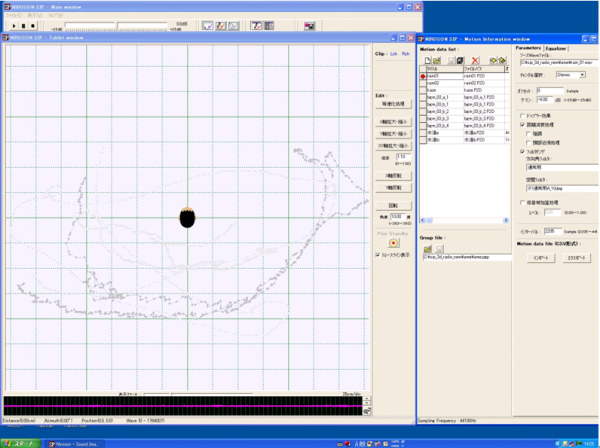
We finished collecting data and began to develop the software. That
took two years to complete. The picture below shows what the software
looks like once installed on a computer. As you navigate the sound field
as represented on the screen, the digitally processed signal fed to the
speaker will produce sound localized at your chosen points in virtual
space.
To be continued…
However, we discovered that there was too much divergence from the
direction in which we were heading. As a result, we had to give up on
this idea. Since we ended up developing our own system from scratch,
we now enjoy the advantage of having absolute control over all aspects
of sound presentation effects.
Flashback: Speaking of Dolby Dr. Ray Dolby, founder and chairman
of Dolby Laboratories, came to Japan in 1972 and visited several
important consumer electronics manufacturers to promote Dolby noise
reduction. Having successfully launched the Dolby A system for
professional applications, he was having difficulty getting a foothold in
the consumer market with his B-type system. As a last resort, he
decided to demonstrate this concept to Nakamichi. At the time, I was
also working on a noise reduction technology of my own. We agreed to
work together, and he stayed with us in Japan for approximately one
month. One year later, Nakamichi introduced the Model 1000, the
world's first true high-end cassette deck, equipped with Dolby B
noise reduction. The rest, as they say, is history. The lowly cassette
became a serious high-fidelity recording medium, and Dolby B noise
reduction became a worldwide standard for cassette decks and
prerecorded music tapes.
Back to Niro S.I.P. technology development
We finished collecting data and began to develop the software. That
took two years to complete. The picture below shows what the software
looks like once installed on a computer. As you navigate the sound field
as represented on the screen, the digitally processed signal fed to the
speaker will produce sound localized at your chosen points in virtual
space.
To be continued…
2005,08,14, Sunday
Before we moved to our current building, we had over 5600 sq. ft. of
office space. We needed to move to a larger facility for Niro S.I.P.
technology development because we needed over 7200 sq. ft. to obtain
sufficient data. We built a large dome shaped laboratory that was over
3600 sq. ft. in size. Inside this dome, we installed 100 B&W LM-1
high-end speakers and a dummy in the center called Mr. Neutrik. It
might look very strange to you, but this is how we developed the Niro
S.I.P. software that you enjoy today.
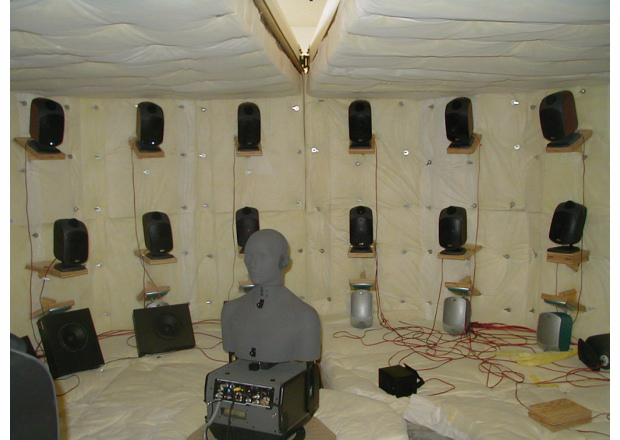
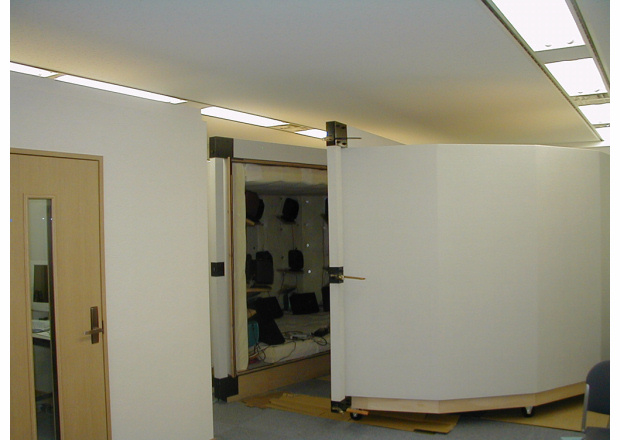 The picture on the left was taken inside
the dome.
The picture on the right shows the outside
of the dome facility.
This unique lab enabled us to get the very precise data needed
to develop our current product. Late at night, when we would be
adjusting the setup of speakers in the dark, I would often be frightened
by Mr. Neutrik, who seemed to loom out of nowhere. This is how we
started the S.I.P. technology development process.
To be continued
office space. We needed to move to a larger facility for Niro S.I.P.
technology development because we needed over 7200 sq. ft. to obtain
sufficient data. We built a large dome shaped laboratory that was over
3600 sq. ft. in size. Inside this dome, we installed 100 B&W LM-1
high-end speakers and a dummy in the center called Mr. Neutrik. It
might look very strange to you, but this is how we developed the Niro
S.I.P. software that you enjoy today.
The picture on the left was taken inside the dome.
The picture on the right shows the outside
of the dome facility.
This unique lab enabled us to get the very precise data needed
to develop our current product. Late at night, when we would be
adjusting the setup of speakers in the dark, I would often be frightened
by Mr. Neutrik, who seemed to loom out of nowhere. This is how we
started the S.I.P. technology development process.
To be continued
2005,08,03, Wednesday
Development has begun! As I explained earlier, hardware design and
microcomputer software programming is done by a team in the U.S. The
DSP software that controls the surround effect is done by a team in Japan.
I am responsible for the development of the main unit and speakers. It is
very important and challenging to work as a team and collaborate with
people from different cultures. Our American engineer often comes to
Japan to work with the team here. The entire team used to have lunch
together, but this engineer would only eat hamburgers and sandwiches.
He tried Japanese style lunches, but he soon gave up because, according
to him, the fish were staring at him. When the Japanese staff travels to
the U.S., the engineer from California takes us to a Japanese noodle
restaurant. The way he eats these noodles is very different from how we
eat in Japan—we make noise, while he eats silently. It may sound strange
to you, but it is perfectly normal to make noise when eating noodles in
Japan.
But enough about cultural differences… Let's get back to our product
development story. Unlike most companies, we don't create specification
sheets during the development stage. If you design to a specification
sheet, you tend to focus on the numbers (data), making it too easy to
neglect important aspects, such as subjective sound quality factors. We
believe that the most important thing is not the specs but, rather, how the
listener judges the sound. At the core of our technology is a desire to
provide a sophisticated sensory experience while keeping the “nuts and
bolts” hidden from the listener. Because our product is a device that lets
you enjoy sound, it is sound on which we must focus our attention.
Sound quality is our first priority when creating our products… so much
so that we are willing to sacrifice certain sound presentation effects to
gain sonic improvement… or, more often, to avoid sonic degradation.
You can listen continuously to high-quality sound for hours on end
without ill effect, but if you listen to distorted sound for a long time, you
will lose the ability to hear precisely. We are continually advancing our
technologies so that you will be able to enjoy more impressive sound
presentation effects without adversely affecting basic sound quality. That
is why we feel it is so important that you have a quick and easy way to
upgrade your system.
That's enough tech talk for now. Here is another demonstration file you
can download. Enjoy the unusual 3D sound experience:
mp3
microcomputer software programming is done by a team in the U.S. The
DSP software that controls the surround effect is done by a team in Japan.
I am responsible for the development of the main unit and speakers. It is
very important and challenging to work as a team and collaborate with
people from different cultures. Our American engineer often comes to
Japan to work with the team here. The entire team used to have lunch
together, but this engineer would only eat hamburgers and sandwiches.
He tried Japanese style lunches, but he soon gave up because, according
to him, the fish were staring at him. When the Japanese staff travels to
the U.S., the engineer from California takes us to a Japanese noodle
restaurant. The way he eats these noodles is very different from how we
eat in Japan—we make noise, while he eats silently. It may sound strange
to you, but it is perfectly normal to make noise when eating noodles in
Japan.
But enough about cultural differences… Let's get back to our product
development story. Unlike most companies, we don't create specification
sheets during the development stage. If you design to a specification
sheet, you tend to focus on the numbers (data), making it too easy to
neglect important aspects, such as subjective sound quality factors. We
believe that the most important thing is not the specs but, rather, how the
listener judges the sound. At the core of our technology is a desire to
provide a sophisticated sensory experience while keeping the “nuts and
bolts” hidden from the listener. Because our product is a device that lets
you enjoy sound, it is sound on which we must focus our attention.
Sound quality is our first priority when creating our products… so much
so that we are willing to sacrifice certain sound presentation effects to
gain sonic improvement… or, more often, to avoid sonic degradation.
You can listen continuously to high-quality sound for hours on end
without ill effect, but if you listen to distorted sound for a long time, you
will lose the ability to hear precisely. We are continually advancing our
technologies so that you will be able to enjoy more impressive sound
presentation effects without adversely affecting basic sound quality. That
is why we feel it is so important that you have a quick and easy way to
upgrade your system.
That's enough tech talk for now. Here is another demonstration file you
can download. Enjoy the unusual 3D sound experience:
mp3
